An AI-native agency is a services provider that uses software in-house to deliver finished work to its clients. That is the thesis Y Combinator published on February 2, 2026, under the title "AI-Native Agencies" and championed by Aaron Epstein. An AI-native company means a product or an organization designed around AI.
Search Google in French for "agence ia native" and the top results mostly discuss AI-native companies. Google's AI Overview, as of November 9, 2026, does not cite Y Combinator. A buyer looking for a provider therefore lands on the wrong question.
How this was checked. This teardown draws on Y Combinator's official post and video, YC's April 2026 post, Sequoia's essay, and a CNBC interview, all reread on November 9, 2026. The Vibe Company describes itself as an AI-native agency and went through Y Combinator (W24), so the author has a stake in the subject.
AI-native agency vs AI-native company: two different buying questions
An AI-native company and an AI-native agency do not meet the same need. At IBM, AI-native refers to a product or an architecture designed around AI from the start. Alfie Suite defines the AI-native company by the way it designs its processes. Both pages describe a client that is transforming itself.
The AI-native agency, in YC's sense, is a supplier. It uses AI in-house to deliver finished work. The client has nothing to reorganize. These are two different buying questions.
AI-native agency according to YC: the software stays in-house, the client gets finished work
On February 2, 2026, Y Combinator summed up the thesis of Aaron Epstein, a partner at YC, in one sentence: "Agencies have always been hard to scale. AI flips this model by letting firms use software internally to deliver finished work at higher margins…" In the video attached to the same post, he spells out the problem: "Agencies have always been crazy hard to scale. Low margins, slow manual work, and the only way to grow is to add more people."
AI changes the math. "Now, instead of selling software to customers to help them do the work, you can charge way more by using the software yourself and selling them the finished product at 100 times the price." His examples are concrete. A design studio produces custom work before the contract is even signed. An ad agency creates videos without a shoot. A law firm drafts its documents in minutes, where it used to take weeks.
His conclusion fits in one line: "agencies of the future will look more like software companies with software margins." They will grow far bigger than today's agencies. YC's Requests for Startups page no longer contains this section as of November 9, 2026. The stable source remains the dated post and its video.
AI-native services: in April 2026, YC targets the companies that do the work
On April 27, 2026, Y Combinator extended the thesis in a post signed @gustaf, under the title "AI-Native Service Companies." The argument is economic: "The total spend on services is many times larger than the spend on software, and a lot of those services are already outsourced, which makes them easier to replace with an AI-native product."
The companies in question sell the service itself. They deliver the work: "they just do the work." The invoice changes in nature.
Sequoia ratio: six dollars of services for every dollar of software
Sequoia puts a number on the same gap in the essay Services: The New Software, by Julien Bek, reread on November 9, 2026: "For every dollar spent on software, six are spent on services." The firm draws a prediction from it. "The next $1T company will be a software company masquerading as a services firm."
The easiest entry point, according to Sequoia, is work that is already outsourced: "If a task is already outsourced… Replacing an outsourcing contract with an AI-native services provider is a vendor swap." The buyer changes suppliers. Its in-house team stays in place.
Classic agency vs AI-native agency: the business model changes
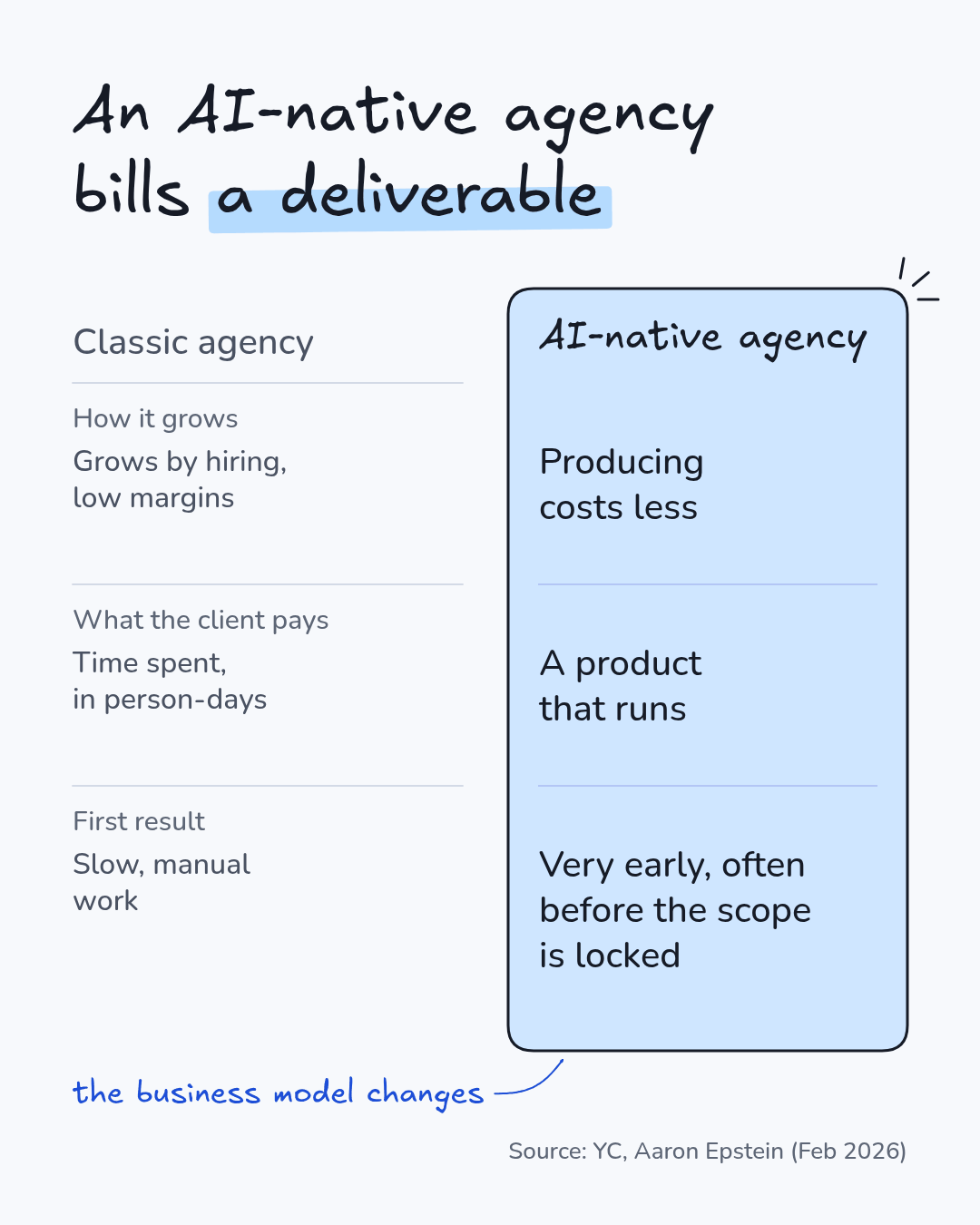
A classic agency grows by hiring, with low margins. With a classic agency or an IT services firm (an ESN, in French), the client pays for time spent, in person-days. The work there stays slow and manual.
For an AI-native agency, producing costs less. It bills for what gets delivered: a product that runs. So it can show something concrete very early, often before the scope is locked.
4 tests to vet an AI-native agency before you sign
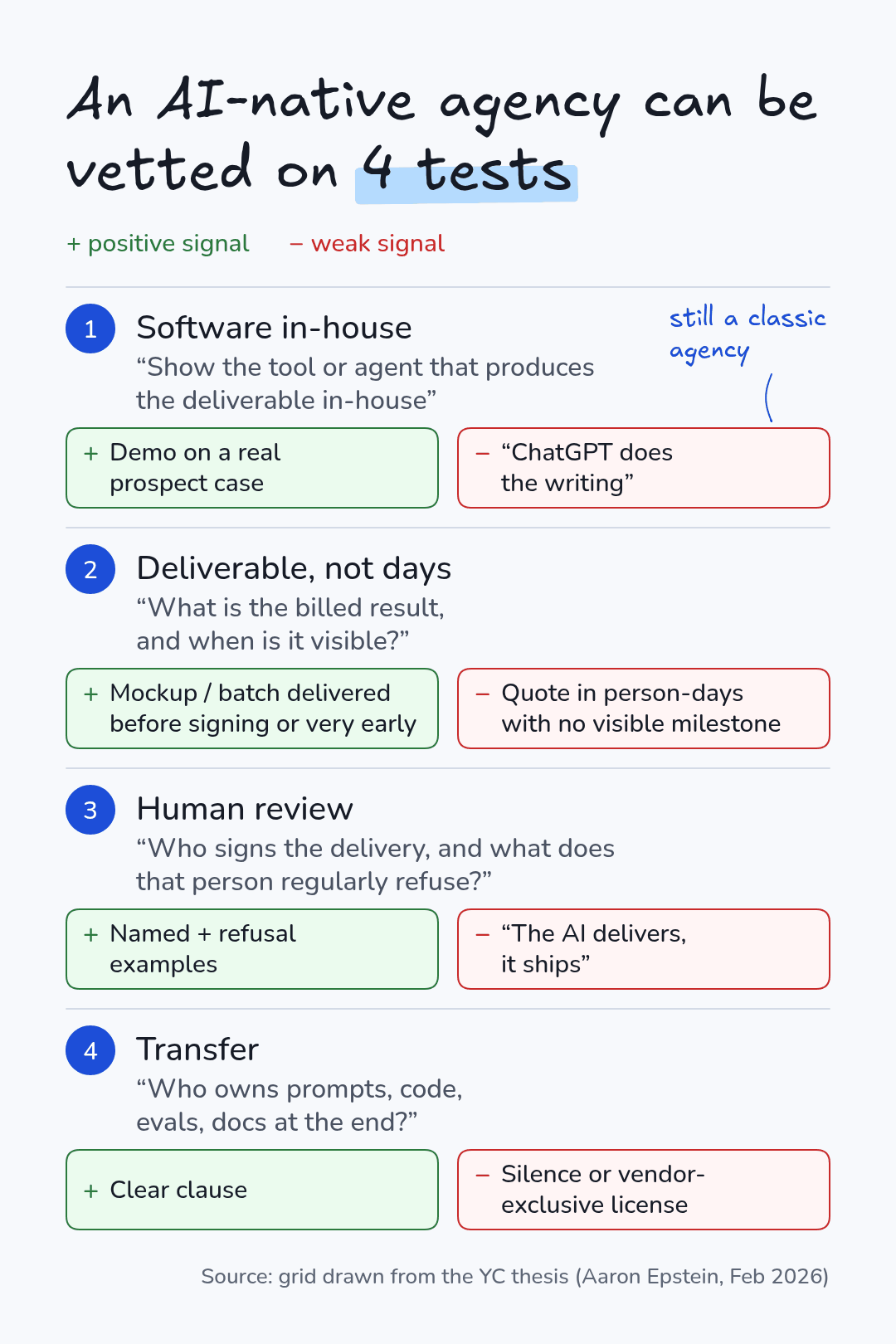
An agency can be vetted on 4 observable tests, which The Vibe Company derived from the YC thesis. Each one can be raised in a meeting, with a precise question.
| Test | What to ask | Positive signal | Weak signal |
|---|---|---|---|
| 1. Software in-house | "Show the tool or agent that produces the deliverable in-house" | Demo on a real prospect case | "ChatGPT does the writing" |
| 2. Deliverable, not days | "What is the billed result, and when is it visible?" | Mockup / batch delivered before signing or very early | Quote in person-days with no visible milestone |
| 3. Human review | "Who signs the delivery, and what does that person regularly refuse?" | Named + refusal examples | "The AI delivers, it ships" |
| 4. Transfer | "Who owns prompts, code, evals, docs at the end?" | Clear clause | Silence or vendor-exclusive license |
The first test targets the agency that only uses ChatGPT. An agency that uses ChatGPT to write is still a classic agency.
The third test protects quality. Moving fast does not mean shipping unchecked. Someone has to answer for every delivery.
The 4 tests apply to The Vibe Company too
This teardown is written by an AI-native agency, and therefore by an interested party. A mid-size company (an ETI, in French) or a large enterprise can put the 4 tests to The Vibe Company, as to any other provider.
Limits: investor theses, with no measure of the agency market
The sources of this teardown are theses. YC publishes a request for startups, Sequoia an investor essay. Neither counts AI-native agencies or measures their margins.
The CNBC figures cover YC startups from winter 2025. They say nothing about agencies. So go back to the opening question: a buyer judges an AI-native agency on what it delivers, using the 4 tests.
FAQ
Is an AI-native agency just an agency that uses ChatGPT?
No. At an AI-native agency, AI is at the core of production. Coding agents produce every day, and the team is organized around them to scope, review and sign off. Test 1 in the grid is to ask for a demo of the tool or agent that produces the deliverable, on a real case.
Who is accountable for what's delivered?
The team. Agents produce, but every delivery is reviewed and approved by a senior person who answers for it. Ask who signs off on the delivery and what that person regularly rejects. A named answer, with examples of rejections, is a good sign. "The AI delivers, it ships" is a weak signal.
Do you work with sensitive data?
Yes. HDS (the French health data hosting standard) and security are among the three specialties of The Vibe Company, alongside frontend and DevOps. In these areas, rigor matters as much as speed. Agents speed up production, and the team reviews and approves every delivery before it goes to the client.
How do I get started?
With a 30-minute call with Stan, to understand your need and see what can be shown to you quickly. Bring a concrete project. You leave with a first idea of how to build it. You then decide based on what you have seen.
Talk to Stan about your project
Want to see what an AI-native agency can deliver for your teams? Bring your need. Book 30 minutes with Stan.
The Vibe Company was founded in Paris in 2024 by Stan Girard and Antoine Dewez (ex-Theodo, ex-Stockly). After going through Y Combinator (W24), it raised $1.7M, is backed by France 2030 through MediaGen, and has run dozens of projects.