What an AI agency actually does: from audit to production
An AI agency designs, builds and ships AI tools: audit, prototype, systems integration, evals. Real engagement flow, roles, deliverables, Monka lesson.
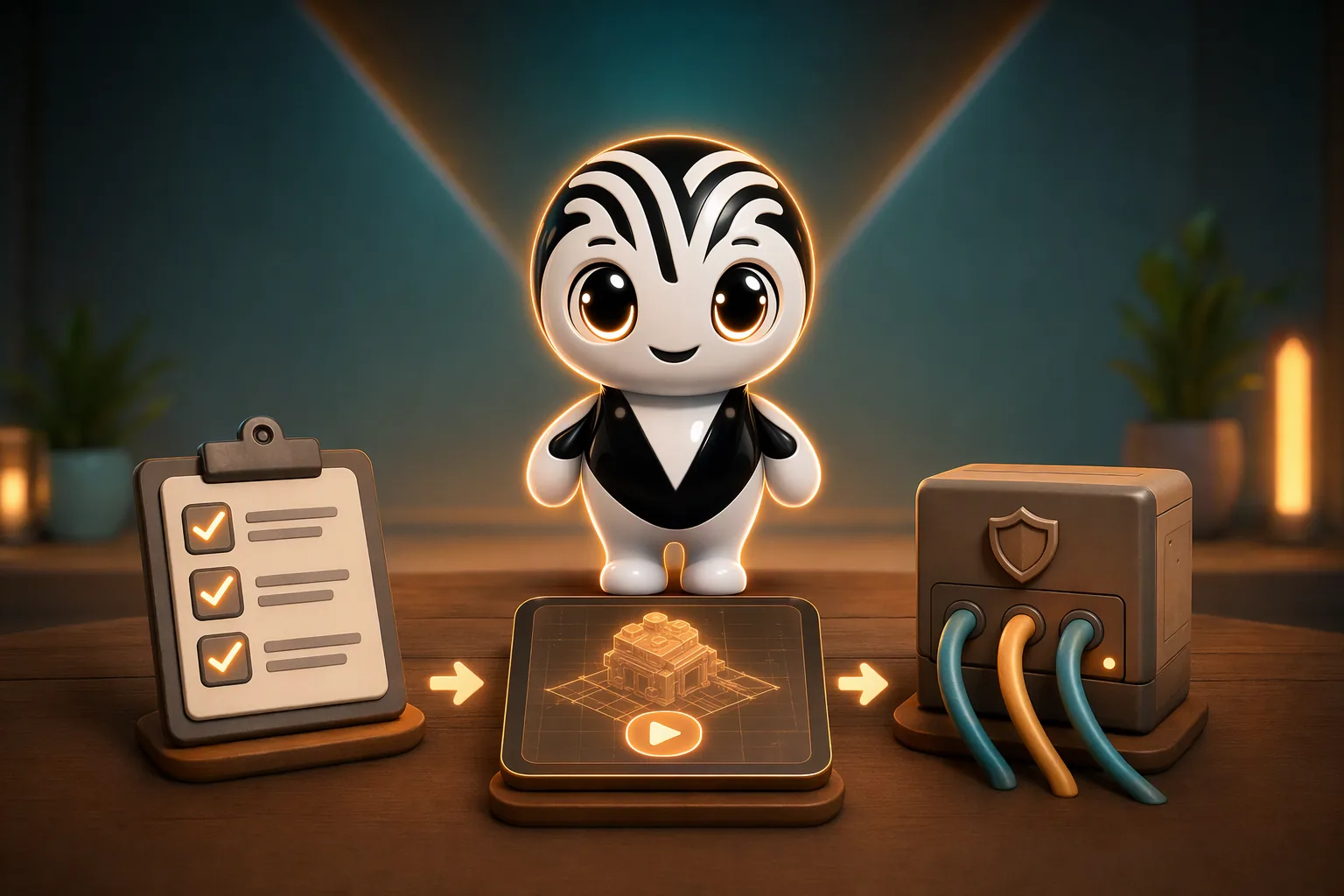
An AI agency designs, builds, and deploys artificial intelligence systems for other businesses: it picks use cases, prototypes, integrates into the existing stack, then measures quality over time.
Not a "top 10 agencies" list, and not a vague automation pitch. Below is the real engagement flow: what happens at each step, who works on it, what you must take home, and what happens when you move too fast. Anchor: Monka, where we had to slow down so the business side could catch up.
What is an AI agency?
An AI agency (or AI development / consulting agency) turns a business need into a usable AI system: an agent, RAG over documents, automation wired into your tools, or a full product. It designs, builds and ships for other companies.
Don't mix it up with:
- an IT services firm: mostly staff augmentation on time and materials;
- a management consultancy: strategy, governance, multi-country programs, rarely the production code;
- a freelancer: strong on one precise task, limited when you need front-end, back-end, infra and security together;
- an "AI automation agency" in the Make/Zapier sense: no-code workflows. Fine for simple flows. Not the same job as an engineering agency that wires LLMs, agents and your systems of record.
In 2026 most AI agencies don't train models. They connect existing models (RAG, agents, tools) to your data and processes. Training stays the exception.
For the Paris / local angle, see also AI agency in Paris.
Step 1: audit and scoping
Before code, we pin the problem down. Typical questions:
- Which business process, exactly (not "we want AI")?
- Which data exists, where, with which access rights?
- Who decides the output is good enough (ops, support, legal)?
- Should the AI read, propose, prepare, or execute?
- What measurable success criterion after the first batch?
Typical deliverable: prioritized use cases, in / out of scope, architecture sketch, estimate, success criteria. Published paths often follow the same logic (audit, prioritization, prototype, build), for example Jayd's summary.
If scoping produces nothing you can test, you're paying for delay.
Step 2: the prototype
The prototype exists to test the idea with the business, not to win a demo. Show a clickable path or a narrow agent on a real perimeter: real data (or a representative sample), real users, and a success criterion written upfront.
What you validate:
- does the business understand and use the flow?
- does model quality hold on your cases, not a public benchmark?
- what must stay human (approval, send, irreversible decisions)?
What you don't validate yet: full load, full systems integration, long-term monitoring. That's the next step.
Rule we use: when it helps, prototype before you harden everything. That stops a bad process from getting poured into concrete.
Step 3: production
Going live means wiring the tool into reality:
- Systems integration: CRM, ticketing, SSO, internal APIs, permissions;
- data: hosting, logs, test environments, model subprocessors;
- evaluation: versioned test set, thresholds, who signs acceptance;
- monitoring: quality drift, model-call costs, alerts;
- AI rights: read / propose / prepare / execute, with a human on the irreversible.
Without that, you've got a demo. Not a tool.
Who works on your project
On the agency side, a serious engagement usually mixes:
- a product profile (scoping, prioritization, success criteria);
- an AI engineer (RAG, agents, evaluations, prompts);
- developers (front, back, infra, security);
- sometimes a designer when the interface matters.
On the client side you need an available business owner. Without them, the prototype "works" in the lab and dies on adoption. That bottleneck is often worse than the model itself.
What you must take home
Write these deliverables into the contract:
- The code (repo, access, ownership);
- Versioned prompts and skills;
- Evaluation sets (anonymised real cases, thresholds);
- Documentation (architecture, runbook, who does what);
- Access (hosting, keys, logs) and exit / reversibility.
The right standard for any agency: code, prompts and evaluation sets belong to the client. If the answer is "we keep the prompts", that's lock-in, not a partnership.
Case note: Monka, when going too fast forces a slowdown
At Monka (caregiver support), we started on March 9 and the caregiver app went live on May 10, with the nurses' CRM beside it. One thing we learned: we were moving too fast for them. We had to slow down so their team had time to work through the business side. A prototype helped test the idea before everything hardened.
The lesson for an AI agency: code speed isn't adoption speed. A good partner knows when to brake because the business isn't ready, not only when to push commits faster.
AI agency for SMEs vs large groups
- SMEs / mid-market: one clear use case, a small end-to-end team, few committees. That's where The Vibe Company helps most.
- Large groups: often several teams, governance, security, sometimes several countries. Firms like Theodo or Artefact are built for that. We also show up as technical reinforcement or advice (architecture, RAG, agents, evaluation), without pretending to replace a multi-team program.
We don't dunk on anyone: a bad match wastes both sides' time. Who fits which project is in our honest AI agency comparison. Local page: AI agency in Paris.
How to choose next
Once the job of an AI agency is clear, pick the partner. Use the questions in How to choose an AI agency: real production work, named team, first usable deliverable, data, code ownership, stop point after the first batch.
Treat rankings where the author is #1 as discovery lists, not as decisions.
FAQ
What is an AI agency?
An AI agency designs, builds, and puts AI tools into production for a company: use cases, prototype, integration into the existing system, then ongoing quality measurement.
Does an AI agency train models?
Rarely. In 2026 most agencies integrate existing LLMs (RAG, agents, tools). Heavy training or fine-tuning is the exception, often at a model vendor or a dedicated lab.
How long does scoping take?
It depends on the need. What matters is a testable deliverable at the end, not the week count.
How is this different from a no-code automation agency?
A no-code automation shop mostly chains tools like Make or Zapier. An engineering AI agency builds systems on your data and IT stack (agents, RAG, evaluations). Both can coexist; risk and ownership aren't the same.
Talk through your use case
The Vibe Company is an AI agency in Paris. We mostly work with SMEs and mid-market companies that want a tool in production, and as technical reinforcement for large groups. In 30 minutes we'll tell you whether an agency is the right format, even if the answer is no.